University funding
As of 19th October 2026
From the federal budget to the individual university: funding for Austria’s 23 public universities passes through several stages. The following terms are central to this process:
| Term | What it means | 2028-2030 |
|---|---|---|
| Total effective budget for all 23 public universities | Everything that effectively benefits the universities financially during a given period: university budget and relief measures | €16.003 billion |
| – of which: university budget |
The money earmarked in the federal budget for all 23 public universities | €15.893 billion |
| – of which: relief measures |
Financial relief for universities (reduction in non-wage labour costs, rent deferrals), no additional money | €110 million |
| Total amount (§ 12 (2) UG) | Framework for the performance agreements with the 22 public universities under the Universities Act 2002 (UG), divided among three budget pillars | To be set by 31 October 2026 |
| Other legal obligations | Part of the total budget not included in the total amount, such as funding for the University for Continuing Education Krems (UWK) or the IT:U, which are covered by Article 15a agreements between the Federal Government and the federal states as well as by their own legal frameworks | |
| Performance agreement budget | Refers to the budget agreed in a performance agreement – or the combined total of the budgets of all 23 performance agreements | To be negotiated in 2027 |
| Global budget (§ 12a UG) |
The term ‘global budget’ refers to the way in which the funds are used: universities can allocate this budget as they see fit in order to achieve the objectives and plans set out in the performance agreement. | For each university |
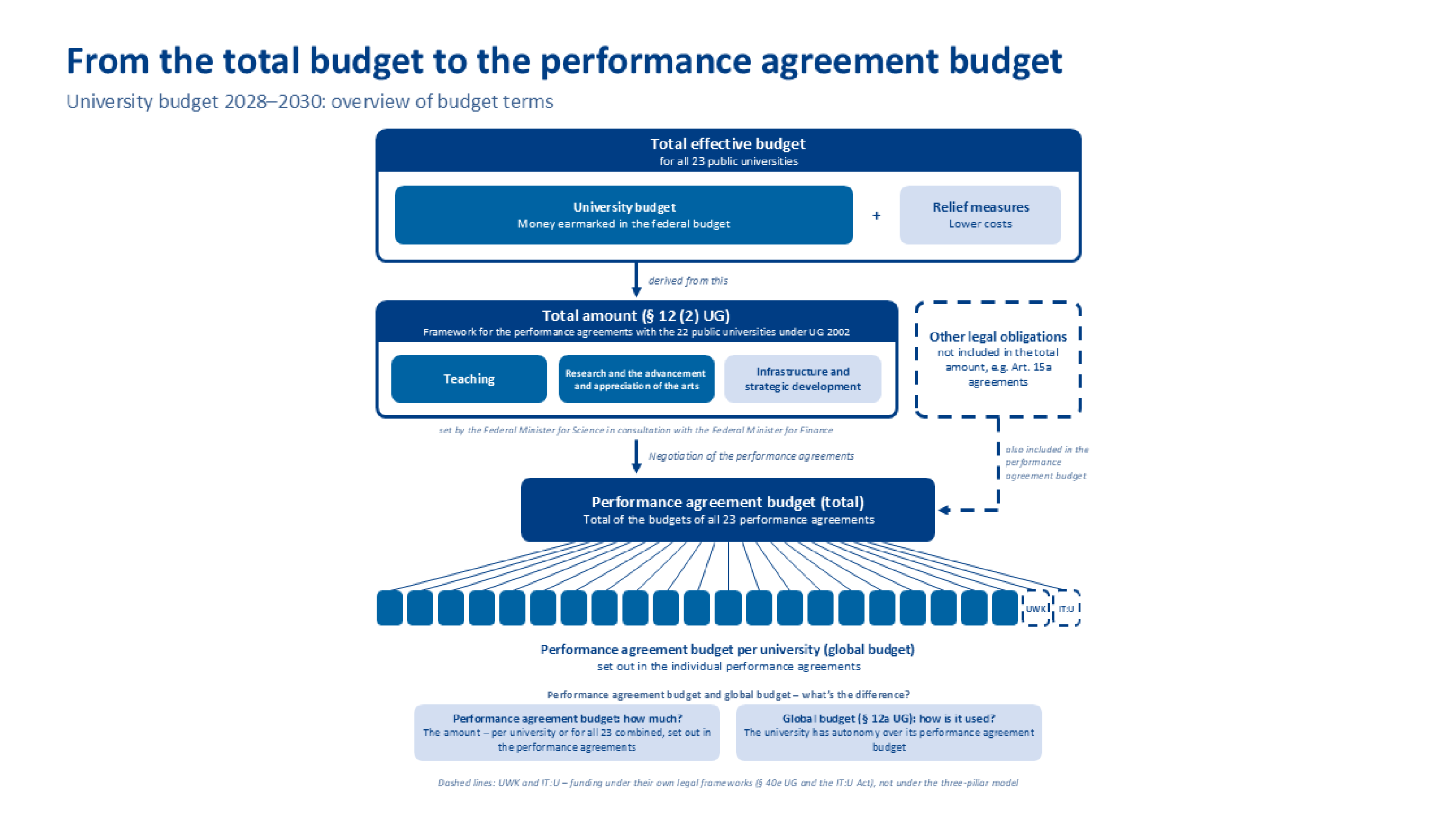
Total budget: around €16 billion for the 2028–2030 period
Despite the need for budget consolidation, the total budget remains at the same nominal level as in the current period. The total effective budget of €16.003 billion comprises:
- €15.893 billion for the university budget
- around €50 million in relief measures through the reduction in non-wage labour costs
- €60 million through the deferral of rent payments and investment expenditure at the Federal Real Estate Company (BIG).
The anticipated price and salary increases are not covered by this amount. However, in line with the Federal Government’s stated objective, the current salary extensions for doctors at the medical universities and the Faculty of Medicine in Linz are safeguarded. For full details, see: University budget 2028–2030: FAQs.
How the total budget has developed since 2019:
| Period | Total budget | Change from previous period |
|---|---|---|
| 2019–2021 | €11.0 billion | +€1.3 billion |
| 2022–2024 | €12.3 billion upon conclusion of the performance agreements; €13.2 billion including compensation for inflation | +12% |
| 2025–2027 | €16.3 billion upon conclusion of the performance agreements (including authorisations to exceed the budget); currently €15.994 billion* |
+€3.1 billion, or +23.5%, compared with €13.2 billion |
| 2028–2030 | €16.003 billion | unchanged in nominal terms* |
* After salary increases for doctors, savings targets and the universities’ contribution to the Research, Technology and Innovation Pact
Total amount: framework for the performance agreements
The total amount under § 12 (2) of the Universities Act is derived from the total budget. The Federal Minister for Science, in consultation with the Federal Minister for Finance, sets this amount by 31 October of the second year of each period for the following period, i.e. by 31 October 2026 for the 2028–2030 period. The total amount is divided among three budget pillars: teaching; research and the advancement and appreciation of the arts; and infrastructure and strategic development.
Other legal obligations: UWK and IT:U
Other legal obligations that are not included in the total amount are also funded from the total budget. These include funding for the University for Continuing Education Krems (UWK), the Interdisciplinary Transformation University Austria (IT:U) in Linz and the Faculty of Medicine at the University of Linz. Separate legal frameworks apply to these institutions: the University for Continuing Education Krems is funded under agreements between the Federal Government and the federal state of Lower Austria (§ 40e UG), while IT:U is funded by the Federal Government, with a contribution from the federal state of Upper Austria, under the IT:U Act. The three-pillar model does not apply to either institution, but both conclude performance agreements.
Performance agreement budgets: for each individual university or combined
Based on the total amount, the Federal Ministry of Women, Science and Research will negotiate a performance agreement with each university in 2027. The budget agreed in each performance agreement is the performance agreement budget for the university concerned, while the combined total of all 23 performance agreements is the total performance agreement budget. From 2025 to 2027, the combined performance agreement budgets of the universities under the Universities Act 2002 (including IT:U) amounted to €14.6 billion.
Global budget: the budget of each university, which it can allocate as it sees fit in order to achieve objectives and plans
Each university receives a ‘global budget’ through its performance agreement (§ 12a UG; different rules apply to the UWK and IT:U). The term refers to the fact that the university has the autonomy to allocate this budget as it sees fit provided that it achieves the agreed upon objectives and plans. The budget is set for a three year period; only the competition-based components are set annually. Universities decide autonomously how to use their funding, including how many positions they fill. Depending on the type of university, the global budget covers between 60 per cent (universities of technology) and 95 per cent (universities of the arts) of the university’s operating expenditure (study conducted by WPZ Research, 2021 (PDF, 3 MB)). Studies by WIFO show that these public funds are well invested.
How the global budget is calculated: the three-pillar model
Capacity-oriented, student-based funding of universities has applied since 2019. This enables teaching capacities to be planned, improves student-teacher ratios and creates incentives for more degree programmes in which students are actively taking examinations and more graduations.
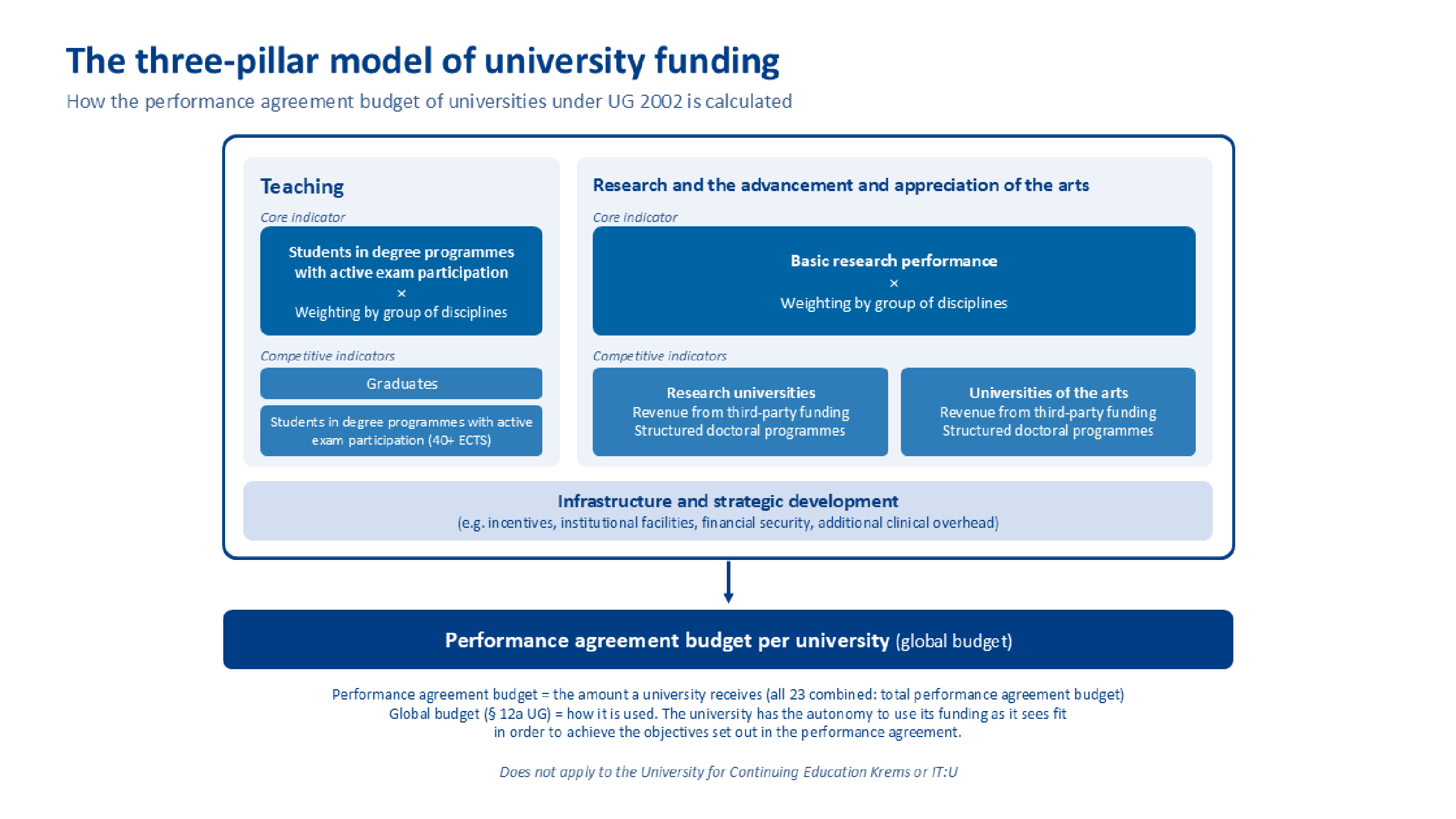
The starting point is the five impact objectives to which the Federal Ministry of Women, Science and Research is committed. These include increasing the number of graduates from tertiary education, creating a higher education and research environment that is competitive in both teaching and research, and ensuring a high degree of cutting-edge research. Universities are awarded particularly large budgets if they use the funds to achieve these objectives.
Budget is calculated mainly on the basis of indicators
Except in the case of the University for Continuing Education Krems and IT:U, the global budget consists of three components. Only the first two are calculated on the basis of indicators, i.e. target values:
- Teaching: the most important target value is examination activity – a degree programme is considered to have active examination participation if at least 16 ECTS credits are earned per academic year. Each group of disciplines has its own funding rate – from 2025 to 2027, this is around €13,100 per degree programme in group 1 (book-based subjects) and €65,500 in group 7 (arts and music degrees requiring intensive supervision). This component is calculated by multiplying the number of degree programmes with active examination participation by the funding rate.
- Research and the advancement and appreciation of the arts (basic research performance): the key factor is the number of scientific and artistic staff employed by a university, multiplied by a funding rate for each group of disciplines.
- Infrastructure and strategic development: covers special expenditure such as rent and is not calculated using indicators.
The majority of the budget is allocated to universities through this mechanism.
Within this funding model: competition for around €686 million
In addition to the basic indicators, around €686 million (4.2%) will be allocated through competitive indicators from 2025 to 2027. The more successful a university is in these areas, the more funding it will receive.
- Research: acquisition of third-party funding, structured doctoral programmes
- Teaching: as many graduates as possible, proportion of degree programmes with at least 40 ECTS credits per academic year
Legal framework and downloads
- § 12 of the Universities Act – Federal Funding of Universities
- § 12a of the Universities Act – Determining the Universities’ Global Budgets
- WPZ Research: Universitäten als unternehmerisch handelnde Institutionen: Steuerungsrelevanz finanztechnischer Instrumente und Kennzahlen (PDF, 3 MB), 2021 – Brigitte Ecker, David F. J. Campbell, Clemens Danler, Gerald Gogola
- WIFO: The Economic and Societal Impact of Universities in Austria, 2017 – Jürgen Janger, Matthias Firgo, Kathrin Hofmann, Agnes Kügler, Anna Strauss, Gerhard Streicher, Hans Pechar
- WIFO: Economic Effects of Universities: Update, 2022 – Elisabeth Arnold, Kathrin Hofmann, Jürgen Janger, Tim Slickers, Gerhard Streicher
Performance agreements
Each of the 23 public universities concludes a performance agreement with the Federal Ministry of Women, Science and Research every three years. This agreement sets out what the university will deliver in terms of teaching, research and contributions to society, as well as the budget it will receive in return.
What a performance agreement is
A performance agreement is a contract under public law pursuant to § 13 of the Universities Act 2002 (UG), and under the IT:U Act for IT:U. Universities have been autonomous since 2004; the performance agreement is the main instrument through which the Federal Government funds and steers them. The agreement contains strategic objectives and specific target values, such as those relating to examination activity and the student-teacher ratio. These values also help determine the size of the budget. The objectives are based on the Austrian National Development Plan for Public Universities (GUEP). The performance agreement also sets out the university’s global budget (§ 12a UG). Information on how the budget is calculated and the applicable budget terms can be found in University Funding.
Performance agreements 2028–2030: process and timetable
| Date | Action |
|---|---|
| 17 October 2026 | The Federal Government agreed on a total effective budget of €16 billion for all 23 public universities. |
| by 31 October 2026 | In consultation with the Federal Minister for Finance, the Federal Minister for Science sets the total amount for the universities under the Universities Act 2002 – divided between teaching, research, and infrastructure and strategic development (§ 12 (2) UG). |
| by 30 April 2027 | The universities submit their draft performance agreements. |
| by 31 August 2027 | The Ministry provides its response. |
| by 31 December 2027 | The performance agreements are finalised (§ 13 (7) UG). |
| from 1 January 2028 | The new performance agreements take effect. The Ministry and the university will hold implementation review meetings at least twice a year. |
The total amount is the framework, not the outcome: the amount that an individual university receives is set only during the negotiations. The rector conducts the negotiations and signs the agreement on behalf of the university; the university council approves the draft and provides comments before the agreement is finalised.
What a performance agreement contains
Under § 13 (2) of the Universities Act, each performance agreement sets out, in particular:
- Strategic objectives, academic profiles and university and human resources development – based on the development plan and intellectual capital report
- Research and the advancement and appreciation of the arts – including areas of focus through which each university builds its profile
- Study programmes and continuing education – including the number of study places that a university must offer for each group of disciplines; this includes disciplines with admission regulations
- Feasibility of programme completion – measures throughout the entire ‘student life cycle’, including measures for working students
- Social goals – such as increasing the number of women in leadership positions, knowledge and technology transfer, and the social dimension
- Internationality and mobility – including target values for student and researcher mobility
- Cooperations with other universities and institutions
- Indicators for measuring the attainment of objectives and measures to be taken in the event of non-fulfilment
From 2025 to 2027, around €67 million will be withheld for the social dimension and will only be paid out in the third year, once the agreed measures have been implemented.
Current period: 2025–2027
The performance agreements for 2025 to 2027 represent the seventh period since 2007 and are the first to include the Interdisciplinary Transformation University Austria (IT:U) in Linz. The combined performance agreement budgets of the universities under the Universities Act 2002 (including IT:U) amount to €14.6 billion. The priorities are:
- Research careers: a key objective is to increase the proportion of permanent employment, particularly among scientific staff funded by third-party funds (postdoctoral researchers). New, forward-looking career paths are also being established. Performance evaluations should take teaching and outreach into account as well as research.
- Artificial intelligence: training, standards for the use of AI and academic integrity, a shared technical environment for all universities and increased cooperation
- Medicine: continuation of the Uni-Med-Impuls 2030 programme, with an increased number of study places in human medicine, further development of the study programme and more attractive general practice; plus the Ignaz Semmelweis Institute for infectious disease research
- Science communication: this has long been part of the universities’ third mission, but it is now a distinct focus area in performance agreements for the first time. Universities are expanding their outreach efforts and participating in initiatives of the Federal Ministry of Women, Science and Research such as Discover.DNAustria and the Science and Democracy Ambassadors programme. Science communication will also play a greater role in teaching, degree programmes and research careers. The aim is for all students, teachers and researchers to come into contact with it and help strengthen trust in science and democracy.
Impact: more degree programmes in which students are actively taking examinations and improved student-teacher ratios
Since 2019, the proportion of degree programmes with active examination participation has risen from 57 per cent (2016/17) to 64 per cent (2023/24). It currently (2026) stands at 66.6 per cent and has thus already reached the target value originally set for the end of the 2027 period. Since 2019/20, the student-teacher ratio has improved from 42 to just over 36 students per teaching staff member (2024/25).